Women’s T20 World Cup Match Prediction Framework 2026 (Complete Analytical Guide)
Posted on March 5, 2026 by admin
Complete Structured Analysis Guide
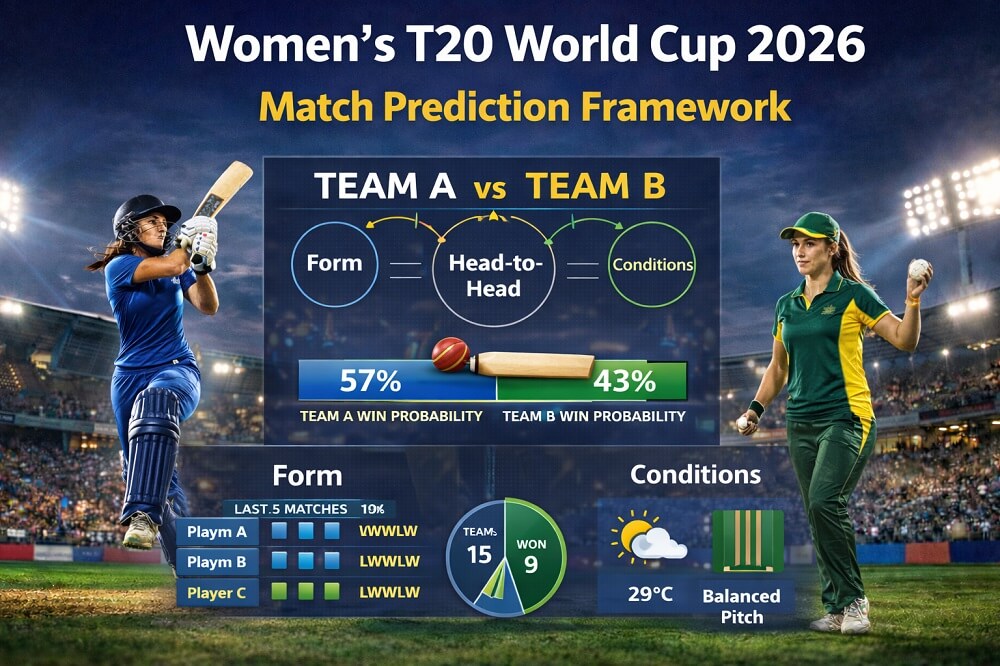
Predicting match outcomes in T20 cricket requires a structured approach. In the Women’s T20 World Cup 2026, multiple factors influence results, including team form, venue conditions, player performance, and tactical balance.
Instead of relying on assumptions, a systematic prediction framework helps analyze matches logically.
This guide presents a step-by-step analytical method to evaluate Women’s T20 World Cup matches effectively.
Why a Prediction Framework Is Important
T20 cricket is dynamic and unpredictable.
A structured framework helps:
✔ Reduce guesswork.
✔ Improve consistency in analysis.
✔ Evaluate multiple variables.
✔ Understand match context clearly.
Comprehensive evaluation increases analytical accuracy.
Step 1: Analyze Team Form
Start by reviewing recent performance:
- Wins and losses in last 5 matches.
- Consistency in scoring.
- Bowling stability.
- Overall momentum.
Teams with strong recent form often perform better in tournaments.
Step 2: Evaluate Squad Balance
Check team composition:
- Batting depth.
- Bowling variety.
- Presence of all-rounders.
- Bench strength.
Balanced squads adapt better to different conditions.
Step 3: Study Venue Conditions
Venue analysis includes:
- Pitch behavior.
- Boundary size.
- Historical scoring trends.
- Chasing vs batting-first success rate.
- Venue context significantly influences match dynamics.
Step 4: Review Powerplay Strength
Early overs determine momentum.
Consider:
- Opening partnership quality.
- New-ball bowling attack.
- Average powerplay scoring.
Strong starts improve overall performance probability.
Step 5: Analyze Middle Overs Control
Overs 7–15 are critical for:
- Maintaining run rate.
- Building partnerships.
- Spin management.
Teams performing well in this phase often post competitive totals.
Step 6: Evaluate Death Overs Capability
Final five overs influence:
- Total score.
- Chase completion.
- Match finishing strength.
Check for:
- Specialist finishers.
- Death-over bowlers.
- Boundary percentage in final overs.
Death overs often decide close matches.
Step 7: Consider Net Run Rate Impact
In group stage tournaments:
- Net Run Rate can determine qualification.
- Margin of victory matters.
- Consistency across matches is important.
- Teams may adjust strategy to improve run rate.
Step 8: Assess Player Performance Trends
Evaluate:
- Individual consistency.
- Strike rate.
- Economy rate.
- Form in recent matches.
- Players in good form can significantly influence outcome.
Step 9: Review Match-Ups
Matchup analysis includes:
- Batter vs bowler statistics.
- Spin vs pace performance.
- Historical head-to-head data.
- Strategic matchups improve tactical advantage.
Step 10: Analyze Psychological Factors
Consider:
- Pressure in knockout matches.
- Experience in global tournaments.
- Leadership stability.
- Mental strength often influences high-pressure games.
Combined Evaluation Approach
A strong prediction framework integrates:
✔ Team form
✔ Squad balance
✔ Venue analysis
✔ Phase performance
✔ Player trends
✔ Tactical matchups
Holistic analysis improves accuracy.
Common Prediction Mistakes
❌ Relying on single metric only.
❌ Ignoring pitch conditions.
❌ Overvaluing star players.
❌ Not considering recent form.
Multi-factor evaluation is essential.
Example Application
Before predicting a match:
- Check recent results.
- Review pitch report.
- Analyze opening pair strength.
- Evaluate bowling depth.
- Compare middle overs control.
- Assess death overs capability.
This structured method reduces uncertainty.
Importance of Adaptability
In tournaments:
- Conditions change between matches.
- Teams adjust strategies.
- Injuries may occur.
- Prediction framework must remain flexible.
Responsible Analytical Perspective
Even with structured analysis:
- Cricket remains unpredictable.
- Momentum shifts quickly.
- Individual brilliance can alter outcomes.
- Framework improves evaluation — not guarantees results.
Final Conclusion
The Women’s T20 World Cup 2026 Match Prediction Framework provides a structured approach to analyzing games logically.
By combining:
✔ Form analysis
✔ Venue study
✔ Squad balance
✔ Phase performance
✔ Match-up data
you gain deeper insight into potential outcomes.
Systematic evaluation enhances understanding of tournament dynamics and improves analytical consistency.
Frequently Asked Questions (FAQ)
1. What is a match prediction framework?
It is a structured method to analyze multiple performance factors before evaluating match outcome.
2. Why is venue analysis important?
Because pitch and conditions directly influence scoring patterns.
3. Should player form be considered?
Yes, recent performance trends are crucial.
4. Does squad balance affect predictions?
Yes, balanced teams adapt better to different situations.
5. Can this framework guarantee correct predictions?
No, it improves analysis but cannot eliminate unpredictability.
